Bringing your dog on the trail is one of the best parts of hiking — but summer heat hits them a lot harder than it hits you, and most folks don’t realize it until their dog is already in trouble. I’ve got my own dog with me on plenty of trail days, and I’ve learned to watch for the signs before they become a problem. Here’s what I want every hiker in Texas, Oklahoma, Arkansas, or Louisiana to know before they head out with their pup this summer.
Dogs Overheat Faster Than You Do
Your dog can’t sweat the way you do — they cool off mainly by panting, and that’s a lot less efficient once the air itself is hot and humid. Add a fur coat and the fact that they’re closer to hot pavement or baked trail dirt, and they’re dealing with more heat stress than you are, even on the same hike.
Check the Ground Before You Check the Trail Map
If pavement or rock is too hot for the back of your hand after five seconds, it’s too hot for their paws. This trips people up constantly, especially on trailheads with paved lots or exposed rock sections. Stick to shaded trail sections during peak heat, or shift your hike to early morning when the ground has had all night to cool down.
Water for Two
Bring more water than you think you need, and bring it for your dog specifically — don’t count on creek crossings or ponds being reliable or safe for them to drink from. A collapsible bowl is cheap insurance. Offer water often, not just when your dog seems thirsty; by the time they’re panting hard, they’re already behind on hydration.
Know Their Warning Signs
Heavy panting is normal. What’s not normal:
• Excessive drooling or thick, ropey saliva
• Bright red or purple gums and tongue
• Stumbling, glassy eyes, or disorientation
• Collapsing or refusing to move
If you see any of that, get your dog into shade immediately, offer water, cool them with wet cloths on the belly and paw pads, and head for the vehicle. Heatstroke in dogs escalates fast and is a genuine emergency — don’t wait it out on the trail.
Match the Hike to the Dog, Not Just to You
Older dogs, short-nosed breeds like bulldogs and pugs, and dogs carrying extra weight are all at higher risk in heat, even if they’re eager to keep going. They’ll often push through discomfort because they want to stay with you — which means it’s on you to make the call to turn around, not them.
A Few Trail Habits That Help
• Hike early morning or evening, skip midday in peak summer
• Choose routes with shade and water access when you can
• Take breaks in shade every 20–30 minutes, even if your dog seems fine
• Keep them leashed near water sources — a hot, thirsty dog will jump into anything that looks wet, algae bloom or not
Your dog trusts you to make the call when they can’t make it themselves. A little extra planning goes a long way toward more summer trail days together instead of a scary one.
See you out there.
— Ray
Random Musings
Beating The Heat: Hiking Safely Now That Summer Has Arrived
If you’ve stepped outside in Texas, Oklahoma, Arkansas, or Louisiana any time in the last few weeks, you already know — summer showed up and it did not ease in gently. Triple digit heat indexes, humidity that hits you like a wall, and trails that can go from “pleasant morning walk” to “dangerous” faster than most folks expect. I’ve guided hikes through more brutal Texas summers than I care to count, and I want to share what actually keeps people safe out there — not just the generic “drink water” advice you see everywhere.
Start Way Earlier Than You Think You Need To
By 9am in July, a lot of our regional trails are already uncomfortable. My rule of thumb: if you’re hiking more than a couple miles, be on the trail by sunrise. Not only is it cooler, you also avoid the worst of the sun exposure on trails that don’t offer much shade — which, let’s be honest, describes a lot of our terrain around here.
Water Is Not Optional, and More Than You Think
A good baseline is about a half liter per hour of moderate hiking in heat, and that number climbs fast with exertion or direct sun exposure. I’d rather see someone hike with a pack that feels a little too heavy with water than run short two miles from the trailhead. If you’re out for more than an hour, bring electrolytes too — plain water alone won’t replace what you’re sweating out, and that’s when people start feeling foggy, crampy, or nauseous.
Know the Difference Between Heat Exhaustion and Heat Stroke
This is the one I really want people to walk away understanding:
• Heat exhaustion looks like heavy sweating, weakness, cool clammy skin, nausea, and headache. Get the person into shade, cool them down, get fluids in them, and rest.
• Heat stroke is a medical emergency. Watch for hot, dry or flushed skin, confusion, rapid pulse, and in some cases the person stops sweating altogether. If you see this, call 911, get the person cooled down by any means available (wet cloths, shade, fanning), and don’t wait to see if they improve on their own.
Knowing this difference has mattered more than any piece of gear I’ve ever carried.
Dress and Pack Like the Heat Is the Real Opponent
Loose, light-colored, moisture-wicking clothing. A wide-brim hat. Sunscreen reapplied, not just slapped on once at the trailhead. And don’t skip a way to cool your neck and wrists — a bandana you can wet at a creek crossing does more work than people expect.
Pick Your Trail With the Season in Mind
Not every trail that’s great in October is a good idea in July. Look for routes with tree cover, water access, or shorter mileage options so you’re not committed to hours of full sun exposure. If you’re not sure which of our regional trails handle summer heat well, that’s exactly the kind of thing I love talking through — feel free to reach out.
Listen to Your Body, Not Your Itinerary
The number one mistake I see is people pushing through early warning signs because they don’t want to “ruin” the hike. Turning around early because you’re overheated isn’t failure — it’s exactly the kind of decision that keeps you coming back to the trail for years instead of learning the hard way.
Stay cool out there, stay hydrated, and I’ll see you on the trail.
— Ray
My TBK (Tiny Big Kit)

I always shake my head when I day hike with people who show up with next to no supplies. Why wouldn’t they want to be ready for an unplanned emergency? If you’ve been to one of my classes you have heard my displeasure with those who hit the trail with their water bottle, chapstick, hair brush, and cell phone. The answers are usually the same…..I’m not getting lost because the trail is marked and besides I have my phone ……..and my personal favorite, I’m not carrying a bunch of extra unnecessary gear.
The news offers plenty of examples of outings turned bad. Many of these outings started out with charged cell phones, well marked trails,and great intentions. Those alone should be reason enough to take your safety seriously but I also wanted to help hikers understand that “prepared” didn’t have to mean a giant backpack. Enter the TBK, the Tiny Big Kit. It was my goal to squeeze as many of the 10 Essentials Of Hiking as I could plus a few comfort items into a compact leg bag. I do though swap this out during winter months to also include extra warm layers. The contents are listed below and assume I’m wearing proper sun protection and usually shove a few snacks in a cargo pocket before leaving home, I am pretty squared away to spend an extra day in the wilderness.
- Poncho Tarp
- Emergency Bivvy Bag
- Cotton Bandana
- Small Wire Saw & Tool Card
- Small & Large Multi tool
- Basic Booboo Kit (I typically carry a tourniquet in my pocket)
- Wipes & Expandable TP
- Good Basic Fire Kit
- Chem Lights & Rechargeable Headlamp
- Battery Pack & Cables
- 25′ Of Paracord (Actually Titan Survival Paracord)
- Primary & Secondary Water Filtering Systems
- Metal Cup & Drink Mixes
- Pen & Pad
- Map & Compass With Whistle
- Maxpedition Thermite Leg Bag

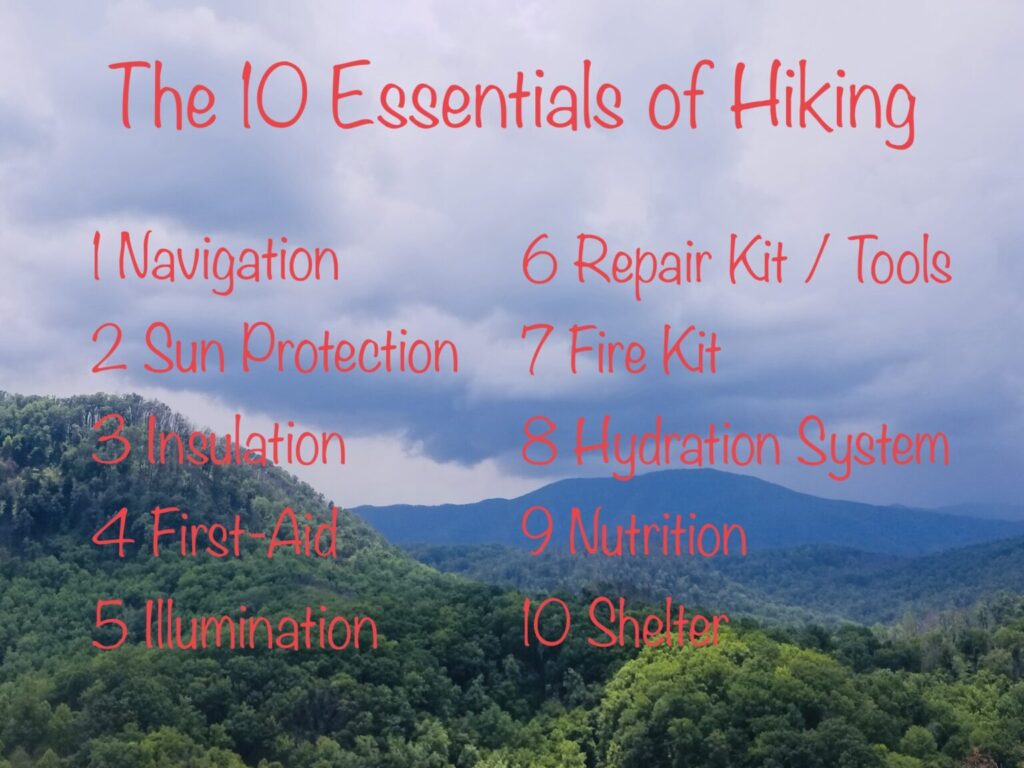
The 10 Essentials Of Hiking

- Navigation – Far too many hikers today rely solely on technology. Yes those phone apps and maps are great but have you ever lost a phone? Broken one? Had a dead battery? A good old map and compass are the perfect backup and can be quite fun to use.
- Sun Protection – Getting extra crispy while hiking never makes for fun. A healthy dose of sunscreen, some sleeves, and a wide brimmed hat go a long way toward keeping you on the trail for longer.
- Insulation – Whether winter or summer, carrying a way to warm up can be a life saver. Even mild temperatures can lead to hypothermia especially if you have also gotten damp.
- First Aid – Often overlooked by hikers, having the ability to treat more than a few blisters can also be a life saver. Pro Tip – find a good first aid course, carry the supplies, and know how to use what you carry.
- Illumination – Once the sun goes down having a headlamp and / or a few chem lights will go along way toward peace of mind and can be useful for signaling.
- Repair Kit / Tools – Whether I need to repair a broken shoe string, pull a honey locust thorn out of my shoe sole, or patch a torn poncho; having some basic repair tools and supplies are always a step in the right direction.
- Fire Kit – This is possibly one of the most multifunctional of the 10 Essentials. Being able to quickly get a fire can help keep you warm, dry you out, signal for help, make water safe to drink, give you light and companionship at night, and even a bit of entertainment.
- Hydration System – Hydrate, hydrate, and then hydrate some more. Never enter the trail without both water and a way to procure more. There are several options for filtering and chemical decontamination methods. Figure out what works for you and then don’t neglect it.
- Nutrition – While none of us will starve getting stuck on the trail for an extra day, having a snack provides more than just a full stomach. It gives us peace of mind and a often needed bump in energy. If you have blood sugar considerations this one is a MUST before hitting the trail.
- Shelter – A hasty means of getting out of a sudden and unexpected change of weather can make the difference in surviving an outing in the right situations. Personally I am fond of ponchos that are convertible to tarp shelter systems.
– R
The COVID Silver Lining?

Sitting here today approaching the summer of 2022 with mask mandates finally disappearing at each turn, I’m wondering what this means for the outdoor industry. The cabin fever that came with 2 years of seclusion has seen more and more people venturing into the ”wild”. If you have tried to pick up a slot at a campground in recent months you surely have noticed how hard they are to come by.
More people discovering the joys of nature is a wonderful thing and I hope this infatuation last much longer than the rona panic lasts. Having said that though, if you pay attention to the news at all you will notice that the incidents of lost or injured hikers has climbed as well. If you are new to the great outdoors do yourself a favor and get educated on essentials skills like wilderness first aid, land navigation, and overall wilderness survival. Your local search and rescue team will thank you.
– R
I Hate This Meme

As the owner of a wilderness survival school who spends time teaching outdoor skills to people from all walks of life, I often get asked what I think of this post. Frequently our classes have seasoned hikers and backpackers who have gotten lost recently….which can be quite the eye opener.
The experience of being lost is enough to motivate them to get better educated. However memes like this meant to poke fun at that person carrying supplies serves to do the exact opposite. Shaming a person who is taking personal responsibility by carrying what they feel is needed for the situation is it self shameful.
I often focus on the day hikers because they are frequently the ones ill prepared to spend the night outside if the need arises. Don’t judge the hiker trying to be responsible by carrying supplies, instead try to educate the hiker who doesn’t see the need to be personally responsible.
– R
Have You Ever Had An Eleanor?
If you have ever seen the old Nic Cage remake of Gone In 60 Seconds, you know that the 1967 Mustang GT500 was his elusive nemesis that he named Eleanor. Every time he had tried to get his hands on one it ended in disaster…..bittersweet but glorious disaster.
Have you ever had a hike that was your Eleanor? A hike that every time you tried to sneak it in, fate reared its ugly head and decided for you that it was not happening.
Mine was Eagle Rock Loop in Arkansas. I had always loved that part of the country around the Ouachitas but have never actually done the almost 30 mile loop. I briefly lived in Little Rock in 2010 when a section of the loop flooded and tragically killed several people so I have a healthy respect for the trail but was also intrigued by the experience of doing it.
Over the course of 5 years I repeatedly made plans in a very packed schedule to finally conquer ERL. Each time, life seemed determined that I would never get to experience it. I could schedule other hikes and rarely ever had issues getting them notched off but this one was always a mystery. At least 4 times I cancelled because there had been enough recent rains to make the river crossings problematic. One time the dreaded work schedule got into the way and yet another time my wife and child were sick so I instead served as chief nurse of our household. One outing got cancelled when my child got into trouble at school but after a visit from the “idea fairy” I decided his punishment was hiking the trail with me the following June when he was out of school in a few weeks. This was a huge mistake. We did actually make it to the trail and managed to knock out about half of it before he tapped out. He was miserable in the heat so we bailed out and headed back home to Dallas. Yet again, my plans were thwarted.
My efforts to complete this trail were beyond frustrating and only salted my wounds. Even my friends started to call it Eleanor. In January of 22 and on very short notice something magical happened. Plans got cancelled and while both the work gods and the weather gods were looking elsewhere, I snuck off alone to ERL on a whim. The forecast was dry but chilly into the 20s, which I love. I told almost no one other than my wife and son where i was going. This weekend Eleanor was going down or I was.
I was so eager to shake the monkey from my back that I flew through the trail over the course of 2 days and two nights. I slowed down to take pictures but even those were sparse. This trip was no longer about enjoying the scenery or even taking in the experience, it was 100% about exorcising the demon named Eleanor and it was glorious. When I realized I had completed it far faster than I had planned, I did regret hustling through it but at the same time now I know which areas are worth drinking in and which areas you just hike on through.
Have you ever had an Eleanor? Did you ever wrestle it into submission? Was it what you imagined it would be or like me, did the struggle to win change the motivation for you? I would love to hear your story.
– R